How to write AI sales agent instructions that guide the work
Define the audience, research fallback, message boundaries and next action. A practical brief informed by a read-only review of a real Lineer campaign configuration.
AI sales agent instructions need to explain what to do when the expected information is missing. An agent told to personalize every introduction still needs a decision for prospects with no relevant public activity, an unclear role or a reply that changes the conversation. Those decisions belong in the brief before the campaign starts.
A current Lineer campaign configuration shows how specific those instructions can become. In a read-only review on November 16, 2026, we found an ordered research fallback, restrictions on the offer, a defined message structure and explicit reply-handling rules. We also found different timing values in the stored strategy and written sequence. This guide uses that one configuration to illustrate what to check, then provides an adapted brief you can use as a starting point. It does not measure campaign performance.
1. Define the audience and the conversation you want
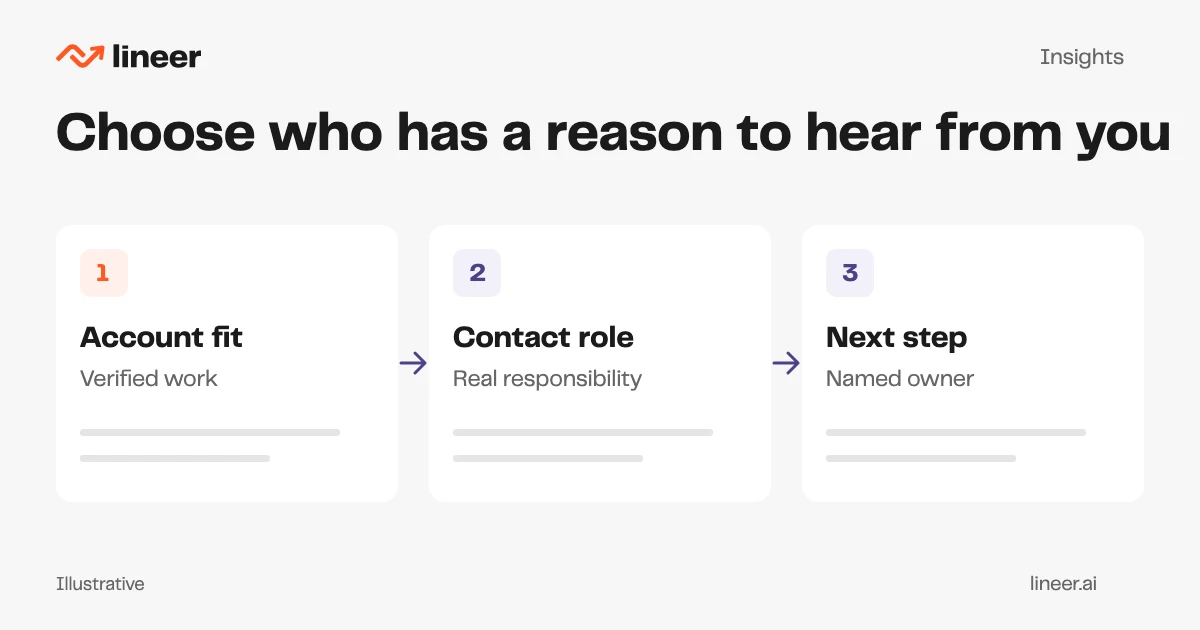
A useful brief connects the recipient’s work to a reason for making contact. A job title, an industry and “book a meeting” leave important decisions open: whether the person buys the service, advises buyers, or might be a partner. Define the relationship you want before asking the agent to write the introduction. Our prospect selection guide covers the ICP and contact-selection process that comes first.
The reviewed campaign describes specialist service providers and the expertise they could contribute to an industry event. Its instructions limit detailed promotion and rule out claims of guaranteed leads or preferential access to buyers. Those boundaries give the agent a narrower proposition than “sell the event.” They are evidence of the current configuration’s intent, not proof that every earlier message followed it.
An adapted brief for a supplier-review service could say: “Contact operations leaders at companies that coordinate suppliers across multiple sites. Introduce our supplier-review preparation service and ask how they prepare for renewals. Do not assume that their current process is broken.” The service and audience here are fictional; replace both with an offer and audience you have already validated.
2. Specify what counts as usable research
A research instruction becomes actionable when it names both a source and a relevant finding. “Research the prospect” does not explain whether a personal post, a company service page or a hiring announcement supports the proposed conversation. Give the agent a reason to use a finding, as well as a place to look for it.
The reviewed configuration sets an ordered route: relevant recent activity from the person, then specific company information, then a supplied fallback if neither produces something suitable. It also requires findings to be real and verifiable. We have verified that this rule is present in the current prompt; this review did not measure how often each route was used or independently validate every research result.
Missing research should change the message rather than become an invented observation. In the adapted brief below, the fallback removes the personal reference and asks a plain question about responsibility. An alternative is to hold that prospect for human review. Choose a policy that fits your campaign and check whether the agent’s enabled tools support the required research.
| Research state | Recommended instruction | Review check |
|---|---|---|
| Relevant personal activity found | Use one specific observation and retain the source in the research record | Does the source support both the fact and its relevance? |
| Only relevant company information found | Describe the company fact without attributing it to the person | Are you implying personal involvement that the source does not establish? |
| No useful information found | Use an approved plain introduction or hold for review | Has the draft invented a trigger, compliment or need? |
| Evidence conflicts with the proposed audience | Hold for review rather than forcing the introduction | Does this person belong in the selected segment? |
3. Make the email demonstrate the rule
An example helps a reviewer see how the instructions should affect the draft. The reviewed campaign specifies a short three-part structure: an observation, a connection to the offer and a low-pressure question. That is one configured approach, not a proven best length or a universal format. The example below adapts the structure to our fictional supplier-review service.
Email anatomy
An introduction governed by a research rule
Select a marked passage to see its purpose.
Evidence boundary Fictional editorial adaptation of the reviewed prompt’s observation, offer and question structure. No sent email, reply or performance result is attributed to this example.
The opening is only usable if the company source actually supports it. If research cannot verify multiple sites, replace that sentence with the approved plain introduction or hold the prospect for review. The example is a way to inspect the instruction’s meaning; it is not permission to reuse a fictional observation as a real fact.
4. Check that the written sequence agrees with the settings
A polished prompt can still contain a workflow conflict. The reviewed configuration stores a three-day follow-up interval and five maximum attempts in its strategy, while the custom text describes a follow-up after one week and a final email two weeks after that. Those stored values and written instructions do not describe the same sequence. This audit did not establish which values governed any particular send, whether the older strategy fields were active, or whether the difference caused an error.
The practical check is to agree the intended sequence, inspect the applicable settings and examine the planned next action before letting the campaign continue. Record what “attempt” means in the configuration, when the interval starts and which event stops further contact. Do not assume that changing prose updates every setting, or that a stored field proves the effective runtime behavior.
Approval requirements also need a separate check. Lineer’s approval controls determine which configured actions wait for review. A sentence asking the agent to seek approval should not be treated as proof that the sending tool requires it. Review the tool configuration alongside the instructions, then inspect a test action’s actual state.
5. Give uncertainty and human replies explicit outcomes
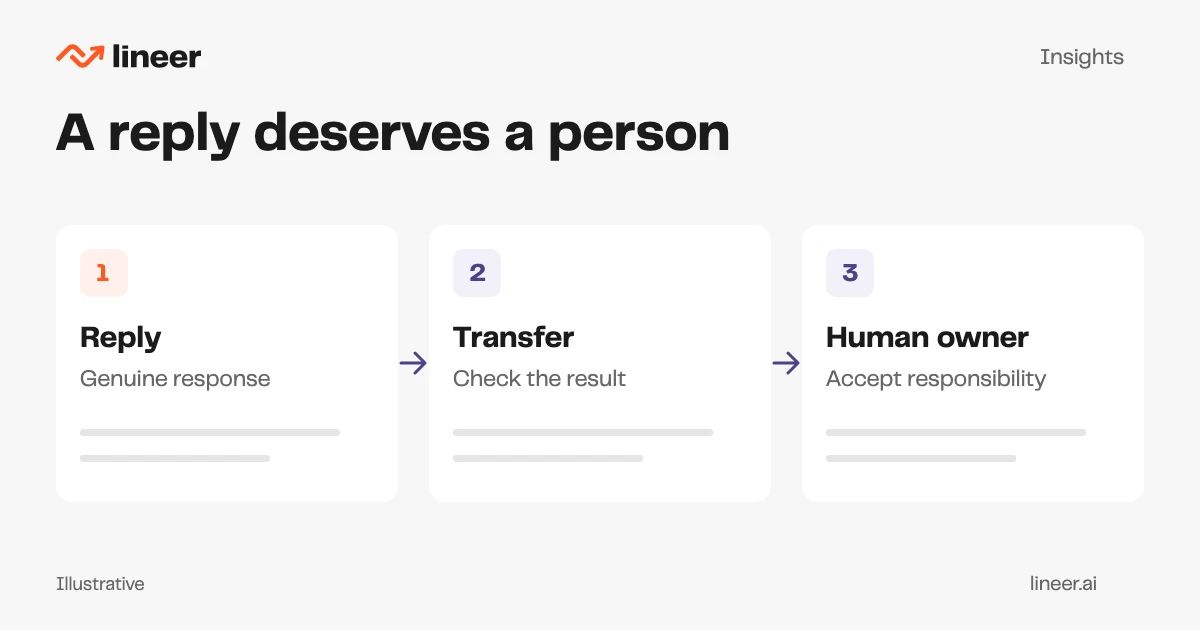
A boundary needs a next action so that the agent does not have to improvise the handoff. The reviewed configuration has structured forwarding fields and written instructions to forward a genuine reply, avoid responding automatically and end the automated conversation after forwarding. This matches Lambros Photios’s recommendation that a person takes over when a human responds, whether the response is positive or negative.
A failed transfer still needs a person responsible for resolving it. The adapted brief adds an exception-review requirement, but that recommendation is not evidence of a built-in recovery guarantee. Confirm the available tools and inspect the transfer result. Our human handoff guide explains ownership, transfer checks, follow-up timing and when a call may be more useful than continuing by email.
6. Test a small set of decisions before expanding
The most useful test cases cover the branches the agent might otherwise miss. Review a prospect with relevant personal research, one with company information only, and one with no useful finding. Separately check how your configuration handles a genuine reply, an automated notice and a failed internal transfer. Use a controlled review setup; do not send test outreach to real prospects just to exercise a branch.
Evaluate the actions as well as the wording. A fluent draft can reference an unsupported fact, wait for the wrong interval or continue after a human reply. Anthropic’s guidance on evaluating agents distinguishes the agent’s sequence of actions from the resulting outcome. For this workflow, that means inspecting the research, draft, approval state and planned next step rather than scoring the email alone.
Adapted agent brief
Adapt the placeholders to your campaign.
- Audience
- [validated segment and relevant role].
- Purpose
- [one supported offer and the conversation to open].
- Research
- use a relevant personal source, then a company source. Retain the source with the research. Never invent activity, responsibilities or need.
- Fallback
- if no useful fact is verified, use our approved plain introduction. Hold conflicting audience evidence for review.
- Message
- one supported observation, one connection to our offer and one answerable question. Follow the approved examples without copying their fictional facts.
- Claims
- use only approved capabilities and proof. Do not promise outcomes.
- Sequence
- [agreed interval and attempt limit]. Verify the applicable settings and planned next action agree.
- Approvals
- configure the relevant tools for review and confirm an actual pending action behaves as intended.
- Replies
- hand genuine human responses to the named owner. Do not automatically answer them. Check the transfer result and stop automated prospect follow-ups.
- Exceptions
- hold uncertain cases for review. Assign failed internal transfers to an exception owner.
- Version
- [date, reviewer, configuration reference].
Keep a dated copy of the instructions and settings you approved. If the campaign later behaves differently, a current prompt cannot establish what an earlier run received. This review’s campaign was updated after the October thread used to locate it, so we have not attributed that thread’s reply or forwarding outcome to the current wording.
What this review can establish
This is a targeted configuration example, not a representative campaign study. We selected one parent campaign through a previously reviewed thread and read its current stored configuration on November 16. The record’s update timestamp was November 9. We examined the research hierarchy, writing boundaries, reply-handling fields and timing instructions; no production data was changed.
The review establishes that these instructions and settings were stored together at the time of retrieval. It does not reconstruct a historical prompt, measure compliance, compare prompt versions or estimate reply uplift. The brief, test cases and annotated email are editorial adaptations. They contain no customer identities or private message text.
The next step is to review your own campaign’s decisions before expanding it: who belongs in the audience, what supports the introduction, what happens without evidence, and when a person takes over. Explore Lineer’s agent setup to see where instructions fit alongside tools and approvals.