Lead reactivation: how to restart a quiet B2B conversation
The reason a prospect went quiet should determine the next email. Explore Lineer’s message audit and four annotated examples for restarting B2B conversations.
The reason a prospect went quiet should determine how you contact them again. Someone who asked you to return after budgeting needs a different email from someone who never replied. A contact already speaking with a colleague may need no further outreach. Before drafting, establish what happened in the earlier exchange and whether there is a credible reason to reopen it.
This guide uses a review of actual campaign settings and sent-message records in Lineer. The examples are fictional adaptations and editorial recommendations. They are not proven winning scripts.
What we found in Lineer’s records
Campaigns configured for re-engagement can contain both first-contact outreach and repeat contact. We found that mixture when inspecting 1,465 completed send and reply action records from four campaigns with re-engagement instructions, covering August 1 through November 3, 2026, UTC. Their campaign labels alone could not identify a clean group of dormant prospects.
Some messages acknowledged earlier outreach without identifying a specific change worth discussing. Of 944 opening send actions, 78 explicitly said the sender had reached out earlier. In 38 of those 78, the reason to reconnect was a general suggestion that circumstances may have changed.
A reminder of earlier outreach provides context; a specific reason to reconnect gives the recipient something to consider. A verified change, an answer to an earlier question or an agreed return date explains why the discussion is relevant now. That is our editorial recommendation, not a measured improvement in response rates.
The current instructions distinguished situations that should lead to different actions. They separated unanswered outreach, earlier interest, existing relationships and open conversations that should return to a person. These settings describe intended behavior; they do not establish that every sent message followed the instructions.
The audit establishes wording and configuration patterns, but cannot identify the most effective reactivation approach. We did not verify the earlier exchange for every recipient, establish a consistent period of inactivity or link a confirmed reactivation cohort to meetings or revenue. The 78 messages are a wording count, not 78 verified dormant leads. We cannot use these records to name a best-performing template or promise a reply rate.
What is lead reactivation?
B2B lead reactivation is a deliberate attempt to restart contact with a prospect whose earlier outreach or sales discussion has gone quiet. It can involve an unanswered introduction, a postponed discussion or an opportunity that closed because the timing was wrong.
An inactive CRM record does not establish that a prospect needs another email. A recent reply may sit in another mailbox, an account owner may have a meeting booked, or the contact may have changed roles or asked you to stop. The record’s age is a reason to inspect the history before deciding what to do.
This guide focuses on B2B prospects. Customer win-back campaigns and ecommerce promotions involve different relationships and offers.
Reactivation requires a fresh decision about whether and why to reopen contact. A routine follow-up within the original unanswered sequence has a narrower job: to remind the recipient or clarify the introduction. Our cold email follow-up templates cover that earlier stage.
Sort the history before writing the message
The last meaningful exchange determines what you can accurately say and whether another message is appropriate. A request to return later supports a specific next step; unanswered outreach establishes only that you sent something. Segment the records on that basis before drafting:
| What the record shows | What to check | Appropriate next step |
|---|---|---|
| Earlier outreach, no human reply | Original topic, contact details and whether the offer is still relevant | Acknowledge the outreach accurately and provide a specific reason to write again |
| Interest followed by a request to return later | Their exact request and whether that date or condition has arrived | Pick up the agreed next step |
| A discussion stopped at a concrete blocker | Whether that blocker has actually changed | Explain the relevant change and ask whether the discussion is worth reopening |
| A conversation or meeting is already active | Account owner and current next action | Hand it to the owner; exclude it from the reactivation send |
| A decline, opt-out or invalid address | The recorded response and contact status | Respect the response; suppress opt-outs and invalid addresses |
An unanswered email does not establish a relationship. Avoid “when we spoke” if the only history is a message you sent.
A clear decline also deserves a different decision from silence. Do not put it into a generic restart campaign because a fixed number of days has elapsed.
Choose a reason to reconnect
A reason to reconnect is stronger when it explains what makes the discussion relevant now. The useful detail might come from the prospect’s earlier request, your ability to answer it, or a verified change in circumstances:
- They asked you to return in a particular month.
- You can now answer a question that held up the discussion.
- A capability they needed is available and you have verified it.
- A relevant business change creates a plausible reason to revisit the topic.
- A resource you offered is ready and addresses the question they raised.
A public announcement establishes an event, not the prospect’s need for your offer. It may justify a relevant question, but it does not prove a problem, budget or buying intention. Describe the verified change and let the recipient explain its implications.
When no relevant change exists, the right next step may be to leave the record alone.
Reactivation email examples
These examples use a fictional supplier-review service. Replace every bracketed field with verified information. Only offer materials or capabilities you can provide, and retain your normal sender identification and opt-out details.
Each annotation explains the purpose of the passage. None of these examples has been tested as a template in the audit above.
1. They asked you to return later
An agreed return date can provide enough reason to reopen the discussion. This example refers to the prospect’s actual request and asks whether the priority still applies, rather than assuming the earlier interest remains unchanged.
Email anatomy
They asked you to return later
Select a marked passage to see its purpose.
Evidence boundary Fictional editorial example. The Lineer audit describes wording and campaign settings; it does not establish this template’s performance.
Their request supplies the timing; their response needs to establish whether the opportunity is still relevant. Check the date and topic against the earlier exchange, and offer the outline only if it was discussed and is ready to send.
2. You emailed before, but they never replied
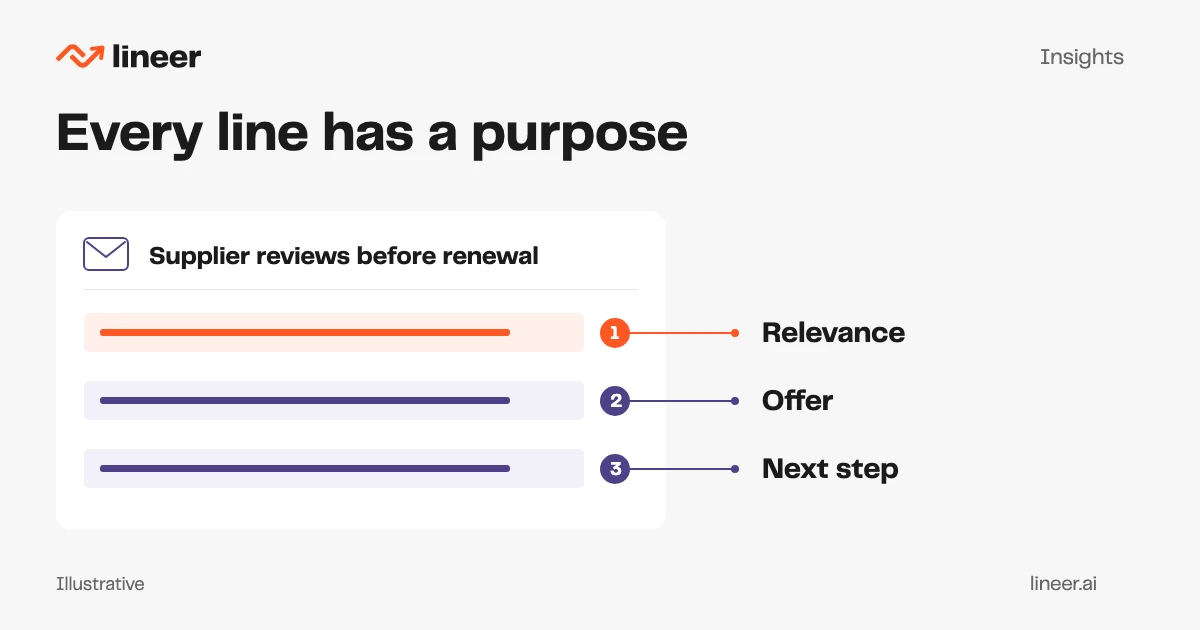
Unanswered outreach calls for an accurate acknowledgment without implying a conversation. This example says when the sender emailed, then uses a verified expansion to ask whether the supplier-review process has changed.
Email anatomy
You emailed before, but they never replied
Select a marked passage to see its purpose.
Evidence boundary Fictional editorial example. The Lineer audit describes wording and campaign settings; it does not establish this template’s performance.
The expansion and the offered pack both need to be real for this message to hold up. If either is missing, choose a reason and offer you can support. Plausible details cannot substitute for verified context.
3. A previous blocker has changed
A resolved blocker gives a previous prospect something new to evaluate. The message connects a specific earlier requirement to a capability you can now substantiate, including any relevant limitation. It leaves the prospect to decide whether the change is enough to revisit the discussion.
Email anatomy
A previous blocker has changed
Select a marked passage to see its purpose.
Evidence boundary Fictional editorial example. The Lineer audit describes wording and campaign settings; it does not establish this template’s performance.
This example is an editorial recommendation. The audit did not establish outcomes for messages about resolved blockers.
4. The restart email received no reply
An unanswered restart email does not automatically justify another follow-up. A closing message is an option when the original reason remains relevant, no reply has arrived elsewhere and one further contact is appropriate.
Email anatomy
The restart email received no reply
Select a marked passage to see its purpose.
Evidence boundary Fictional editorial example. The Lineer audit describes wording and campaign settings; it does not establish this template’s performance.
This is an optional closing message, not a required extra touch. An opt-out, decline or active conversation should stop the sequence before this point.
Timing should follow the relationship
The reason for reconnecting provides a more defensible timing decision than an arbitrary waiting period. Honor an agreed return date, verify a changed capability before announcing it, and check that a business event is still relevant to the original offer. Our audit does not establish an optimal interval between reactivation messages.
A limited sequence makes the decision to stop explicit. As an initial policy, you could choose one reopening email and, where appropriate, one closing follow-up, with the delay set according to the relationship and your normal contact practices. Review that policy against actual responses; the research does not establish it as an optimal sequence.
A new month does not by itself change the case for contacting someone. Another attempt should have a reason you can explain from the relationship or current circumstances, rather than restarting the same campaign automatically.
Set up the reactivation workflow in Lineer
An agent needs the earlier relationship context to draft an accurate reactivation message. In Lineer’s nurture workflow, make that exchange and the reason for returning available before reviewing drafts. A small initial segment makes it feasible to check whether each message reflects the record.
The original topic and latest response explain more than an inactive status can. Record them alongside the agreed return date, owner and reason to reconnect. Keeping unanswered outreach separate from earlier interest helps prevent the draft from implying a conversation that never happened.
The workflow needs to define when the agent should draft, stop or return the conversation to a person. Translate those decisions into instructions you can inspect in the initial segment:
- Check the available history and flag missing or conflicting context.
- Exclude contacts whose recorded status or current conversation makes another email inappropriate.
- Draft around one verified reason to reconnect.
- Route genuine replies to the person responsible for the relationship.
- Stop the sequence at the agreed exit condition.
These are instructions and review requirements you need to configure and verify. They are not a claim that every campaign automatically checks every mailbox or applies every rule.
Approval creates an opportunity to catch a mismatch between the draft and the relationship. Configure email actions to require it while reviewing the segment and wording, then check the recipient, prior exchange, factual claims and next step. Only actions configured to require approval wait for that review.
A successful handoff should leave your team with the prospect’s reply and the context needed to answer it. Another scheduled template should not interrupt the conversation.
Measure renewed conversations separately from replies
A reactivation report should distinguish renewed interest from a request to stop. Count positive interest, useful referrals, requests to return later, declines, opt-outs and delivery failures separately. Record meetings held and reopened opportunities as later outcomes, each with a definition agreed before sending.
Comparable results require comparable relationship histories and response windows. Keep unanswered contacts separate from earlier positive conversations, and count people consistently so several emails to one person do not inflate the denominator.
A campaign-wide reply rate can misrepresent reactivation when it includes first-contact messages. That mixture appeared in our audit. Establish the actual relationship for each included contact before reporting a reactivation result.
Start with one segment you can review
A clear history and a credible reason to return make a reactivation campaign easier to evaluate. They let you check whether the message is accurate, whether its timing makes sense and whether a reply should reopen the opportunity. Start with prospects whose records support those decisions and assign a person to handle their responses.