Does AI-written outreach get more replies?
AI-written campaigns drew more human replies in this sample. Templates drew more positive first replies. Here is what a sales team should measure.
Higher observed human reply rate for fully AI versus templated outreach, within 14 days.
Eligible outreach starts in the primary cohort.
Primary response window, including observed follow-ups.
The short answer
If your team uses AI to write outreach, measure the conversations it starts, not the number of replies alone. In Lineer’s sample, fully AI-written campaigns received more human replies than templated campaigns over 14 days: 2.02% versus 1.20%. Yet templates had the highest rate of positive first replies. A reply that declines the offer still counts as a reply.
These campaigns reached different customers and audiences. The result is a reason to test AI-written sequences with your own prospects, not a forecast of what your team will gain.
What we found
What changes when AI writes more?
Compare human replies and positive first replies across the observed sequence window.
Human replies, 14 days. 14-day observation window.
First human replies / eligible outreach starts.
| Group | Replies | Eligible starts | Reply rate |
|---|---|---|---|
| Templated | 45 | 3,751 | 1.20% |
| Half-AI | 148 | 9,197 | 1.61% |
| Fully AI | 47 | 2,327 | 2.02% |
Each window uses a different eligible cohort, not a cumulative response curve. These are observed rates, not causal effects. The 95% campaign-bootstrap interval for the fully AI minus templated difference was −0.45 to +2.51 percentage points; for fully AI minus half-AI, −0.84 to +2.12 points. Both span zero.
Human replies, 7 days. 7-day observation window.
First human replies / eligible outreach starts.
| Group | Replies | Eligible starts | Reply rate |
|---|---|---|---|
| Templated | 47 | 4,230 | 1.11% |
| Half-AI | 135 | 10,507 | 1.28% |
| Fully AI | 33 | 2,428 | 1.36% |
Each window uses a different eligible cohort, not a cumulative response curve. These are observed rates, not causal effects.
Human replies, 30 days. 30-day observation window.
First human replies / eligible outreach starts.
| Group | Replies | Eligible starts | Reply rate |
|---|---|---|---|
| Templated | 45 | 3,091 | 1.46% |
| Half-AI | 96 | 5,850 | 1.64% |
| Fully AI | 55 | 2,192 | 2.51% |
Each window uses a different eligible cohort, not a cumulative response curve. These are observed rates, not causal effects.
Positive first replies, 14 days. 14-day observation window.
Positive first replies / eligible outreach starts.
| Group | Replies | Eligible starts | Reply rate |
|---|---|---|---|
| Templated | 22 | 3,751 | 0.59% |
| Half-AI | 39 | 9,197 | 0.42% |
| Fully AI | 12 | 2,327 | 0.52% |
Positive first replies were classified only for the 14-day cohort. Templates have the highest observed positive-response yield.
Source: Lineer Research. Snapshot September 10, 2026. Dataset writing, version 1.
Download aggregate data| Writing approach | Outreach starts | Human replies | Positive first replies |
|---|---|---|---|
| Templated | 3,751 | 45 (1.20%) | 22 (0.59%) |
| Half-AI | 9,197 | 148 (1.61%) | 39 (0.42%) |
| Fully AI | 2,327 | 47 (2.02%) | 12 (0.52%) |
Fully AI-written campaigns received about eight more human replies per 1,000 starts than templates at the observed rates. The positive first-reply rates tell a different story: templates led that measure, though the number of positive replies was small.
The apparent winner also changed when we removed individual customers from the comparison. Excluding one workspace brought the fully AI reply rate down to 1.50%, below the half-AI rate of 1.61%. That workspace belongs in the main result; its effect shows how much customer mix matters.
What this means for a sales team
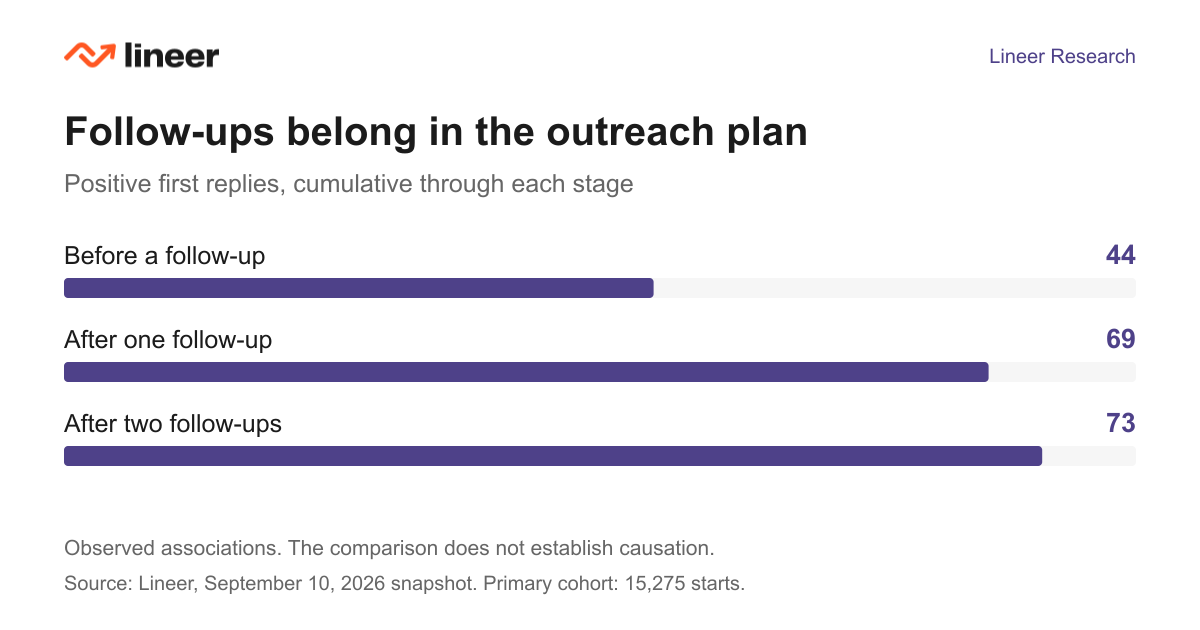
Compare complete outreach sequences over the same period. A first-email report misses replies that arrive after follow-ups. Then separate positive interest, referrals, objections, and opt-outs. Any-reply rate can tell you whether people engage; positive replies tell you more about whether the campaign is opening sales conversations.
If you test writing approaches, use comparable prospect segments, offers, senders, and follow-up schedules. Decide in advance what counts as success. A booked meeting is more useful than a reply count when your systems can track it reliably.
Data and method
We reviewed 15,275 outreach starts across 65 campaigns and 11 workspaces. Opening emails were sent from June 15 through August 27, 2026, leaving every included start a full 14 days for a response before the September 10 data snapshot. Campaigns were labeled templated, half-AI, or fully AI in a supplied classification workbook. We did not verify the authorship of every sent email or follow-up.
Each outreach start counted once. We excluded bounces, out-of-office messages, and automated acknowledgments from human replies. One analyst reviewed first responses and marked a reply positive when it welcomed a conversation or requested relevant information. A positive reply is not a verified meeting or sale.
This is an observational comparison. Customers chose their own writing approach, audience, and offer. Differences between those choices may explain the rates. The estimate for fully AI versus templated human replies was uncertain enough that a campaign-level resampling interval included no advantage. Some historical records lacked the evidence needed for inclusion, and the sample is not verified as exclusively cold outreach.
Lineer operates the platform studied and has a commercial interest in its use. This article shares its cohort with the other two insights; they are not independent studies. Customer and recipient identities are omitted.