What happens after the first email?
Many replies arrived after a follow-up, including positive replies. See why sales teams should plan the sequence and measure reply quality.
Of human first replies arrived after at least one follow-up.
Of positive first replies arrived after at least one follow-up.
Human first replies across 15,275 eligible starts.
The short answer
Judging outreach by its first email leaves out much of the response. In Lineer’s sample, 29 of 73 positive first replies arrived after at least one follow-up. That is 39.7% of the positive replies we observed over 14 days. Follow-ups belong in the campaign plan and in the report you use to judge it.
This does not tell us how many of those people would have replied without another email. It tells us when they replied in the sequences that ran.
Where replies appeared
The response beyond the opening email
Explore first replies through the sends that preceded them.
Human replies, cumulative. 14-day observation window.
Cumulative first replies through each stage; shares use all 240 human responders within 14 days.
| Group | Replies | All responders | Share |
|---|---|---|---|
| Before a follow-up | 110 | 240 | 45.83% |
| After one follow-up | 220 | 240 | 91.67% |
| After two follow-ups | 240 | 240 | 100.00% |
Stages describe sends preceding the first reply, not which email caused it. Counts do not estimate the replies that would be lost without follow-ups.
Human replies, by stage. 14-day observation window.
First replies observed at each stage; shares use all 240 human responders within 14 days.
| Group | Replies | All responders | Share |
|---|---|---|---|
| Before a follow-up | 110 | 240 | 45.83% |
| After one follow-up | 110 | 240 | 45.83% |
| After two follow-ups | 20 | 240 | 8.33% |
Stages describe sends preceding the first reply, not which email caused it. Counts do not estimate the replies that would be lost without follow-ups.
Positive first replies, cumulative. 14-day observation window.
Cumulative first replies through each stage; shares use all 73 positive responders within 14 days.
| Group | Replies | All responders | Share |
|---|---|---|---|
| Before a follow-up | 44 | 73 | 60.27% |
| After one follow-up | 69 | 73 | 94.52% |
| After two follow-ups | 73 | 73 | 100.00% |
Stages describe sends preceding the first reply, not which email caused it. Counts do not estimate the replies that would be lost without follow-ups.
Positive first replies, by stage. 14-day observation window.
First replies observed at each stage; shares use all 73 positive responders within 14 days.
| Group | Replies | All responders | Share |
|---|---|---|---|
| Before a follow-up | 44 | 73 | 60.27% |
| After one follow-up | 25 | 73 | 34.25% |
| After two follow-ups | 4 | 73 | 5.48% |
Stages describe sends preceding the first reply, not which email caused it. Counts do not estimate the replies that would be lost without follow-ups.
Source: Lineer Research. Snapshot September 10, 2026. Dataset followups, version 1.
Download aggregate data| Last send before the first reply | Human replies | Positive replies | Negative replies |
|---|---|---|---|
| Opening email | 110 | 44 | 33 |
| First follow-up | 110 | 25 | 55 |
| Second follow-up | 20 | 4 | 8 |
Of 240 human first replies, 130 arrived after a follow-up. The later replies included real interest, but also more negative responses. A dashboard that counts every reply as a win can hide that difference.
The table shows when a reply arrived, not which email prompted it. People who received a follow-up had already gone without an earlier reply, so the stages are different groups of prospects. The small second-follow-up group cannot tell us the ideal sequence length.
What this means for a sales team
Set a follow-up policy before a campaign starts. Decide when to stop after a reply or opt-out, and give every campaign the same response window before comparing results. In this sample, the median first human reply among people who responded within 14 days came 4.11 days after the opening email. A next-day report would miss much of the observed response.
Report positive replies, referrals, negative replies, and removal requests separately. Review the actual messages, especially when a sequence produces more replies without more interest. If meetings are tracked reliably, include them as a later outcome.
Data and method
We reviewed 15,275 outreach starts from 65 campaigns across 11 workspaces. Opening emails were sent between June 15 and August 27, 2026. Every included start had 14 days before the September 10 data snapshot. We included starts with a confirmed opening send, a retained mailbox, and a matching outbound record.
We linked incoming messages through the campaign thread and mailbox, including replies from a different address. Automated acknowledgments, out-of-office messages, and bounces were excluded. One analyst classified the 240 human first replies. Positive meant the recipient welcomed a conversation or asked for relevant information; it did not mean a booked meeting.
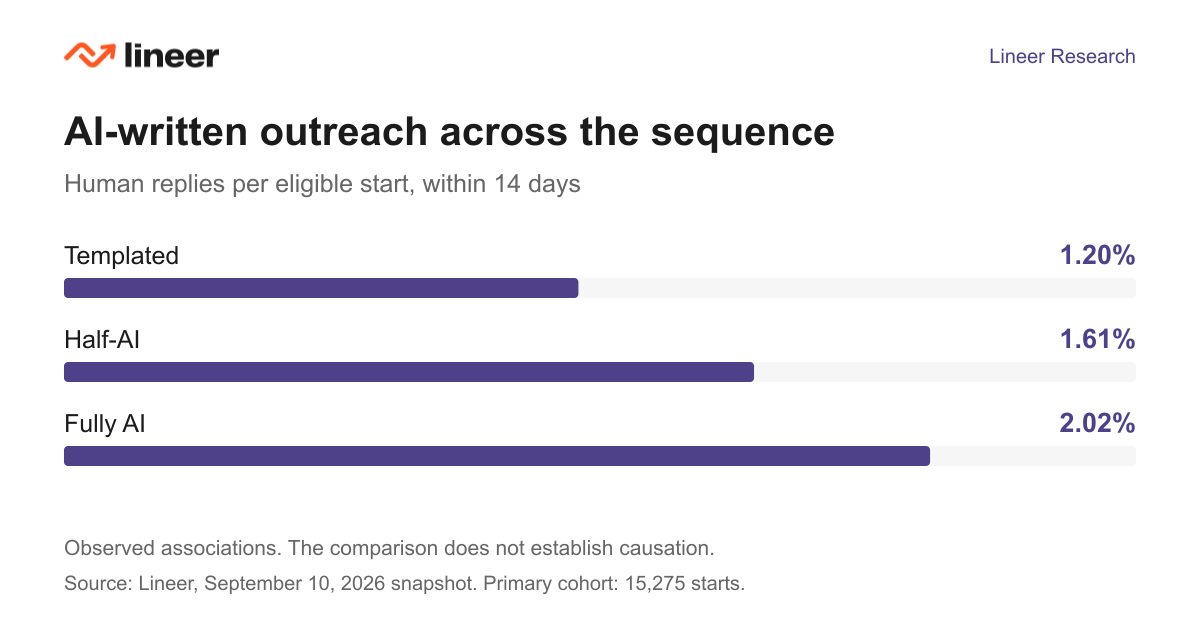
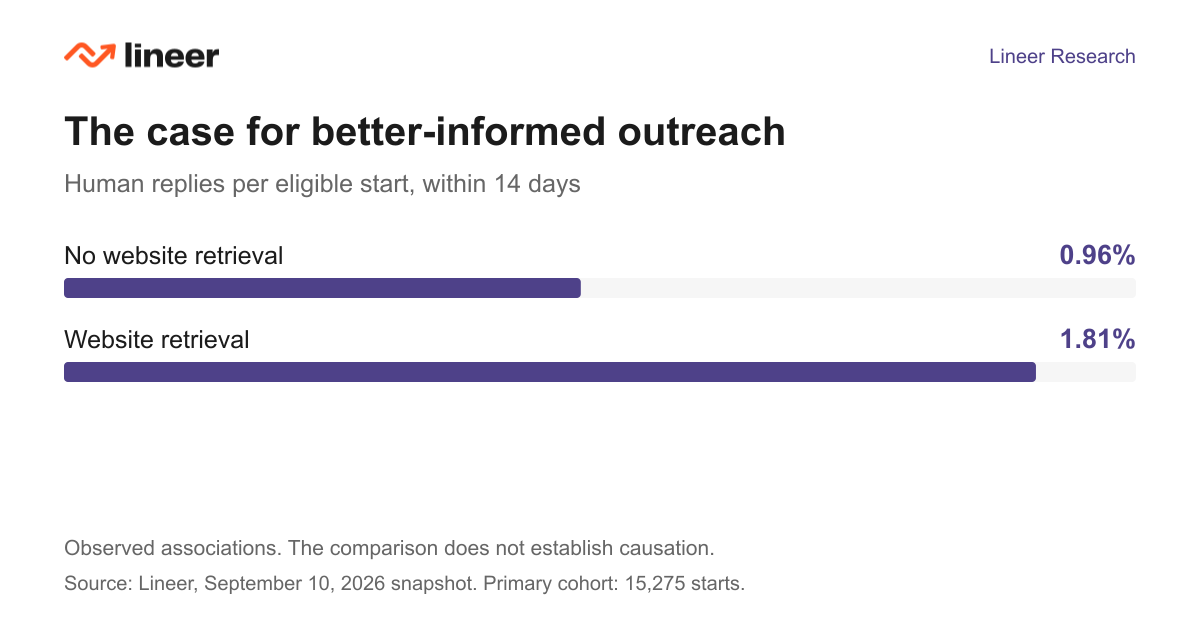
This observational study did not compare a follow-up group with a similar group that received no follow-up. Customers used different audiences, offers, schedules, and stopping rules. A controlled comparison is needed to measure the extra interest a follow-up causes. The cohort is not verified as exclusively cold outreach, and some older records lacked enough evidence for inclusion.
Lineer operates the platform studied and has a commercial interest in its use. This article shares its cohort with the other two insights; they are not independent studies. Customer and recipient identities are omitted.