Founder-led sales: a prospecting plan you can hand over
Build a focused buyer list, review what replies reveal and record the decisions another person needs. Includes a planning worksheet and two annotated emails.
Founder-led sales should turn uncertain assumptions about buyers into a process another person can understand. The founder needs to learn who has the relevant problem, how the offer fits and what makes a prospect willing to take the next step. More outreach is useful only when the resulting conversations help answer those questions.
This playbook sets out a small prospecting plan, a weekly review routine and a practical handoff record. It uses lessons from actual Lineer emails and replies, alongside editorial recommendations. The records were not verified as founder-led campaigns, so they cannot establish a founder advantage, an ideal activity quota or a revenue threshold for hiring a salesperson.
Founder-led sales keeps buyer learning close to product decisions
Founder-led sales means the founder takes direct responsibility for finding suitable buyers, understanding their needs and progressing commercial conversations. That can include research, introductions, discovery, demonstrations and proposals. Its useful output is both a sale and a clearer account of why a customer would buy.
A founder can connect a sales objection to a product or delivery decision while the context is still fresh. If several suitable buyers cannot understand the offer, the problem may belong in the positioning. If they understand it but need an unavailable capability, the decision concerns product scope. Those possibilities call for different responses, and neither is resolved by adding names to a prospecting list.
Direct customer contact also has a place in established startup advice. Paul Graham’s Do Things that Don’t Scale argues for recruiting early users manually and learning through close engagement. The weekly plan below is our suggested implementation of that principle, not a schedule tested in his essay or in Lineer’s data.
A narrow buyer group makes the assumptions easier to inspect
A useful first segment describes relevant work, not just a broad industry and a senior title. In a reviewed Lineer exchange, a vehicle-disposal offer reached an organization that said it had no fleet. The recipient’s operations role did not establish the business prerequisite for the service. An account should meet that prerequisite before the wording of the email becomes the main concern.
Define the work your offer supports and the evidence that would make a company eligible. For a fictional scheduling product, that might be an organization operating field technicians whose jobs are assigned by a dispatcher. An equipment retailer with no field-service operation would fall outside that segment, even if it sits in a related industry. Whether the dispatcher needs new software remains a question, not an established fact.
An exclusion rule is as useful as an inclusion rule because it stops a vague hypothesis from growing into an indiscriminate campaign. Record situations your product cannot serve, required capabilities it lacks and accounts with an existing decline or active conversation. A founder’s network, previous customers and new contacts should have distinct relationship labels; familiarity can affect a reply and should not be mistaken for evidence that the same approach works cold.
The first prospect list should be limited by review capacity
A list is ready for outreach when its relevant facts can be checked and its replies can be handled. Choosing an arbitrary volume first encourages the team to fill gaps in the evidence with assumptions. Begin with a batch small enough for the founder to inspect each proposed contact and continue the conversations that result.
The worksheet below uses a fictional scheduling business to show what a prospecting plan needs to specify. Its values are planning assumptions, not Lineer customer results. Replace them before using the plan. The batch size belongs to your available research, reply and meeting capacity; this audit does not establish an optimal number of accounts.
| Decision | Illustrative plan | Evidence or limit to record |
|---|---|---|
| Buyer group | Businesses that dispatch field technicians | Current source confirming the field-service operation |
| Relevant work | Assigning jobs against technician availability | The actual workflow, still to be confirmed with the buyer |
| Product offer | A shared scheduling view | A capability the product already provides |
| Likely owner | Person responsible for dispatch operations | Current role and whether they own the process or merely use it |
| Account exclusion | No field-service team or an unsupported requirement | The reason for excluding the account |
| Relationship | New contact, referral or existing relationship | Previous conversations, declines and active owners |
| First next step | Offer a relevant product example | A working example ready to share |
| Review capacity | A batch the founder can check and respond to | Named owner, available time and when new outreach pauses |
| Qualification | Relevant need, credible fit and an agreed next action | Buyer statements, unknowns and the next-action owner |
| Review decision | Continue, narrow, revise the offer or stop | What the replies actually showed |
A source note should preserve both the fact and its limits. A website describing field technicians can support an account’s inclusion, but cannot establish that scheduling is broken or that the company has a buying budget. Keep those uncertainties visible so that later readers can distinguish research from a sales conversation.
The first email should make the commercial offer understandable
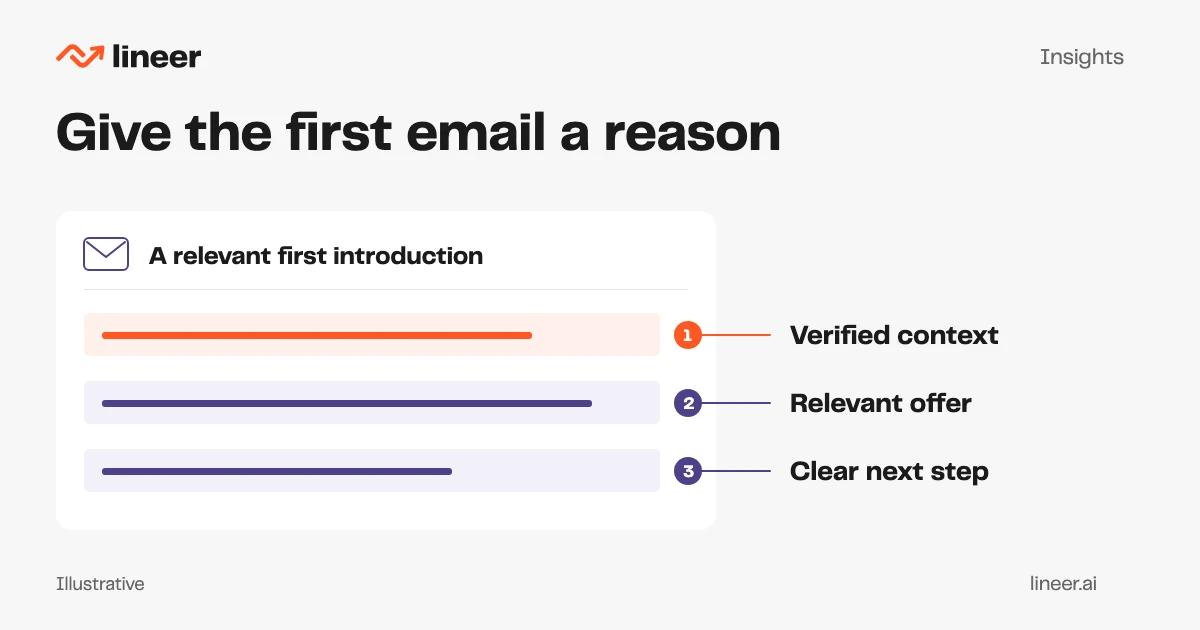
A founder introduction needs to explain what the business provides before asking the recipient to invest time. In the reviewed Lineer messages, some recipients asked what the sender actually offered even after receiving a personalized email. A biography, relevant company fact or invitation to connect can leave the service unclear.
The example below uses the fictional scheduling business from the worksheet. Its founder title identifies the sender; it is not presented as a response-rate tactic. The product capability, recipient context and promised example all need to be accurate before the message is sent.
Email anatomy
A specific offer to a verified buyer
Select a marked passage to see its purpose.
Evidence boundary Fictional editorial example informed by observed offer-clarity and targeting problems. Neither this script nor a founder-title effect has been tested.
A positive-sounding response still needs interpretation. A referral tells you who may own the decision. A question about the product may show that the explanation was incomplete. A request for details creates a task to answer, but does not establish a qualified opportunity. The first-touch templates guide separates these outcomes using the underlying audit.
A weekly routine should reserve time for interpreting replies
A prospecting routine needs room for research, outreach and follow-through. If all available time is allocated to finding new contacts, interested people may wait while the founder repeats work that has already produced a response. Reserve time for the consequences of the outreach before deciding how much more to send.
This weekly pattern is an operating suggestion, not an optimized cadence. Inbound replies should be handled when they arrive; the named review days are not a reason to delay them. Adjust the schedule to the business and leave room for discovery calls, demonstrations and delivery work.
| Point in the week | Main decision | Record to leave behind |
|---|---|---|
| Monday | Which buyer assumption are we examining? | One segment, a specific offer and the uncertainty to resolve |
| Tuesday | Which accounts satisfy the prerequisites? | Checked sources, exclusions and relationship history |
| Wednesday | Is each message ready to send? | A clear offer, an appropriate owner and the promised resource |
| Thursday | What does each reply require next? | Answer, referral, conversation, stop or agreed later return |
| Friday | What should change in the next batch? | Findings, remaining uncertainties and one justified adjustment |
A review should produce a decision rather than a larger activity target by default. Repeated business-type corrections suggest tightening eligibility. Repeated questions about what you do suggest revising the offer description. Requests for prices or scope suggest making those details easier to assess. Silence is less diagnostic: it can reflect targeting, timing, delivery, wording or lack of interest, so it cannot identify the cause on its own.
Information requests need answers before they become opportunities
A buyer asking for commercial details is specifying what they need to assess the offer. In one reviewed reply, the recipient asked about rates for possible borrowing amounts before considering a conversation. That request provided useful next-step information, but it was not acceptance of terms or evidence of a meeting.
The fictional response below applies that lesson to the scheduling business. It assumes the prospect has asked about price and setup, and that the sender has verified the facts needed to answer. If the price depends on an unknown requirement, identify that requirement instead of supplying a convenient estimate.
Email anatomy
Answer an information request before escalating it
Select a marked passage to see its purpose.
Evidence boundary Fictional editorial response to an illustrative request for pricing and setup details. Real reviewed replies asked for commercial information, but this wording has not been tested.
Qualification should describe what the buyer has confirmed and what remains open. For this playbook, an opportunity needs a relevant use case, a credible fit between that use case and the offer, and a next action agreed with the buyer. This is a suggested working definition, not a universal CRM rule. Budget, purchasing authority and timing may still be unknown and should stay marked as such.
A stop or timing request should change the plan immediately. A clear decline should not be converted into another generic follow-up. If a prospect asks to return at a particular time, record the request and owner. The follow-up guide covers unanswered outreach; the reactivation guide addresses a later return when the relationship provides a reason.
Handoff is easier when the reasoning survives outside the founder’s memory
A salesperson or colleague needs more than a prospect list to continue the work. They need to know why an account fits, what the buyer said, what was promised and what is due next. If those facts remain in the founder’s memory, delegation transfers activity while leaving important decisions behind.
A compact handoff record can make those decisions explicit. The following fields are a suggested minimum for this process; they are not a claim that every CRM supplies or enforces them automatically.
| Handoff field | What the next owner needs |
|---|---|
| Account and relationship | Why the account fits and who has already spoken with it |
| Buyer need | The buyer’s stated problem or objective, separate from the seller’s hypothesis |
| Offer and limits | The proposed scope, price basis and requirements the product cannot meet |
| Evidence shared | The exact example, document or demonstration already provided |
| Decision ownership | Known participants, their responsibilities and unresolved authority |
| Next action | What was agreed, who owns it and the actual date or trigger |
| Stop conditions | Declines, contact restrictions, unsuitable requirements or an agreed pause |
| Open questions | What the next conversation needs to establish |
A useful handoff check is whether another person can explain the account and prepare the next action from that record. This is a practical readiness check, not a validated hiring threshold. A growing volume of work may justify help with research or administration while the founder continues to handle uncertain product and commercial decisions.
Automation should carry the recorded process forward
A documented process gives software and colleagues clearer boundaries. In Lineer, an outreach agent can use the configured research tools and writing instructions to prepare work for individual prospects. Configure approval requirements for the email actions you want to inspect; only actions configured to require approval wait for that review. The founder still needs to decide which accounts fit and which promises the business can keep.
The first useful delegation may be repeatable preparation rather than the whole sale. Let the available tools gather context and draft an introduction, then inspect the facts, offer and proposed next step. Keep a named person responsible for replies and commercial decisions. Explore Lineer for founders or review the outreach workflow.
Evidence and limits
This playbook draws on Lineer’s November 6, 2026 audit of 3,097 observed outreach openings across 18 campaigns and eight workspaces. Opening sends ran from October 1–19, UTC, with a 14-day observation window. The audit manually reviewed 45 reply candidates arriving before a second recorded send. Among those, eight corrected business or role fit, three required clarification of the offer and five routed the inquiry toward another owner. The published methodology explains classification and exclusions.
For this article, we rechecked nine retained mailbox messages across four deliberately selected threads on November 9. They illustrated a missing business prerequisite, an unclear offer, referral to a decision owner and a request for commercial details. Their bodies were unchanged from the earlier audit. This was a targeted source check, not a new cohort or a representative sample of founder-led sales.
The records do not verify whether the senders were founders, whether the contacts were all cold, or whether meetings and revenue followed. We do not infer that founders outperform salespeople or that this plan improves conversion. The worksheet, weekly routine, qualification definition, handoff fields and two email examples are editorial recommendations. The examples contain fictional placeholders and assumed seller capabilities; they do not reproduce private customer messages or describe Lineer’s own scheduling features.