How to review AI cold emails before you approve them
Check the facts, recipient fit and proposed next step before approving an AI-written email. Includes a real Lineer role-clarity example and two annotated review exercises.
Accurate research can still produce an email that asks the wrong person for the wrong conversation. Reviewing AI cold emails therefore needs more than a tone check. The reviewer has to establish that the facts are supported, the offer fits the intended relationship and the proposed next step makes sense for that recipient.
A Lineer outreach example illustrates the distinction. Website research described an independent advisory business. The sent introduction referred to that business and proposed a conversation connected to providers in the same sector. The recipient then clarified that they advised clients and did not operate the facilities themselves. That exchange supports a role-clarity lesson; it does not prove the offer had no value or establish a missed sale.
This guide provides a review process for deciding whether to approve, edit or hold a draft. The process is an editorial recommendation. The annotated emails are fictional exercises, not a reconstruction of the customer’s messages or evidence of a human reviewer improving them.
Start with the recipient and the existing conversation
The intended relationship determines whether the email belongs in the campaign. A buyer, an adviser and a potential referral partner can work in the same industry while needing different introductions. Before reviewing the prose, confirm which relationship you want and whether the person’s role supports it. Our prospect selection guide explains the earlier ICP and contact-selection decisions.
Existing contact can change the right next action even when the draft itself reads well. Check earlier messages, requests to reconnect later, declines and contact restrictions. A reply asking for information needs a response from the person responsible for the conversation, rather than another first-touch introduction. If the available history is incomplete, treat that as something to resolve before approval.
Separate a supported fact from an assumed need
A source can support an observation without supporting the sales conclusion attached to it. A website might confirm that a company advises facility operators. It does not follow that the company operates those facilities, controls their contracts or needs the service being offered. Review each step in that reasoning separately.
In the rechecked thread, the research and introduction already recognized the business’s independence. The later reply still clarified its advisory role. That does not tell us why the recipient chose to clarify, or whether a different email would have changed the response. It does show why a reviewer should ask what relationship the proposed conversation assumes, even when the opening uses real research.
A useful check is to read the source beside the sentence it supports. Identify what is known, what is inferred and what is still a question. Remove a claimed renewal date, buying responsibility or operational problem if the available evidence does not establish it. If the missing fact is essential to the offer, hold the draft until someone verifies it.
Review the connection before polishing the wording
A fluent rewrite cannot resolve an unclear reason for contacting someone. The reviewer should be able to explain why the offer matters to this recipient without adding a fact that is absent from the record. If that explanation depends on treating an adviser as an operator, the audience or proposition needs attention before the email does.
The first fictional example below contains a supported observation within the exercise, followed by a question that assumes an unverified responsibility. Its recommended disposition is to hold it. That is an editorial judgment about the exercise, not a recorded decision from the Lineer thread.
Email anatomy
Hold an email that assumes the wrong relationship
Select a marked passage to see its purpose.
Evidence boundary Fictional example created to illustrate a role-fit check. This is not the recorded Lineer email or a documented human edit.
An advisory relationship may still be worth pursuing when it is part of your strategy. Referrals and direct outbound are separate channels, and insights from each can inform the other. The alternative below asks whether the service comes up in the prospect’s advisory work. It belongs in a campaign intended to explore that relationship; it should not be used to disguise a poor fit in a direct-buyer segment.
Email anatomy
A question that leaves an unknown fact open
Select a marked passage to see its purpose.
Evidence boundary An independent editorial alternative for a fictional advisory audience, not a measured improvement or a before-and-after customer email. Use only if referral or advisory relationships fit your strategy.
Make approve, edit and hold mean different things
A review decision is more useful when it records the reason for changing the draft. “Make this sound better” does not distinguish an unsupported claim from a long sentence or a wrong recipient. Record the issue in the review notes or system your team uses, along with the evidence or decision needed to resolve it. These are recommended review categories, not a claim that Lineer supplies this exact set of labels.
| Decision | When it fits | What to record |
|---|---|---|
| Approve | Recipient, facts, relevance, contact history and next step have been checked | The reviewed version and any conditions on sending |
| Edit | The intended conversation is supported, but the wording misstates or obscures it | The specific wording problem and the evidence supporting the change |
| Hold | Audience fit, a factual claim, prior contact or the intended next step remains unresolved | The open question, its owner and what would allow the draft to proceed |
A held draft should not advance merely because someone shortened it. For example, removing a claim that the prospect manages renewals still leaves the team to decide whether an advisory relationship is relevant. Conversely, an accurate, relevant email may need only a small edit to make the question easier to answer. The distinction keeps review effort focused on the decision that matters.
Check the action that approval will authorize
Approval is a workflow decision as well as an editorial one. Lineer’s approval controls let teams inspect configured actions and approve or reject them. Which actions wait depends on the tool configuration, and approved messages still follow mailbox sending limits. Check the pending action and intended recipient alongside the draft rather than assuming that approving the wording means an immediate send.
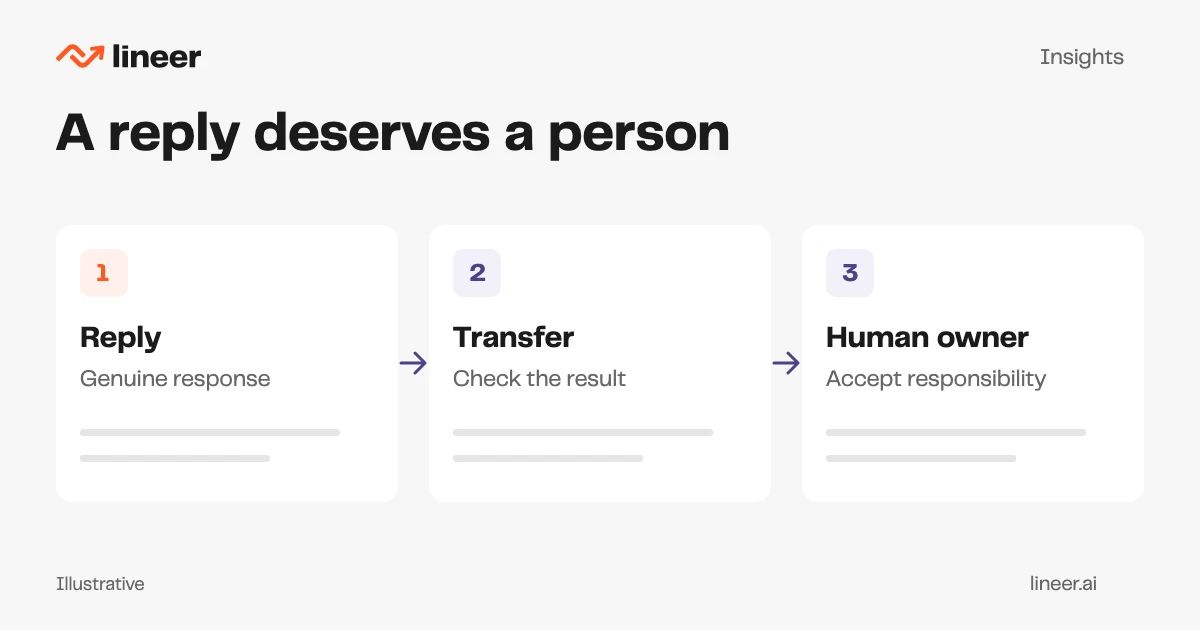
The next step after a human reply also needs an owner. Lambros Photios recommends handing the conversation to a person as soon as a genuine human response arrives, regardless of sentiment. That person can decide whether to answer by email, arrange a call or respect a requested return date. The human handoff guide covers those decisions and transfer checks in more detail.
Use repeated review findings to improve the instructions
Repeated errors tell you which campaign decision needs clarification. If reviewers keep removing invented buying responsibilities, revisit the audience definition and research rules. If the facts are sound but the question repeatedly asks for a meeting before establishing relevance, review the intended conversation and example messages. A single correction is a useful signal to inspect, not proof of a general failure rate.
Keeping the original draft, reviewed version and reason for the change helps the team learn from its decisions. It also makes recurring problems easier to identify when you revisit the campaign instructions. Our agent-instructions guide explains how to turn explicit choices into a campaign brief.
Before you approve an email
Use this checklist alongside the draft and its sources.
- Recipient
- Confirm the person, company and relationship you intend to pursue.
- History
- Check previous contact, replies, requested timing and contact restrictions.
- Evidence
- Open the source behind each specific claim. Remove unsupported details.
- Connection
- Explain why the fact makes this offer relevant to this recipient.
- Question
- Check that the next step does not assume authority, need or timing you have not established.
- Decision
- Approve when supported; edit a wording problem; hold an unresolved fact or audience problem.
- Record
- Note the reason and what must be verified before a held draft can proceed.
- Workflow
- Check the configured approval and planned next action. Hand genuine replies to a person.
About the examples
The real example comes from one Lineer conversation and illustrates a recipient clarifying their role. It does not establish how the email was reviewed or whether a different message would have performed better. The annotated emails are fictional teaching examples, and the checklist is our recommended review process.
A useful review ends with a clear decision about the recipient, the evidence and the next action. Explore Lineer’s approval workflow to see how your team can inspect configured actions before they proceed.