How to respond when a prospect says you have the wrong person
Decide whether to ask for the right contact or close an unsuitable approach. Includes three annotated replies informed by pooled Lineer email data.
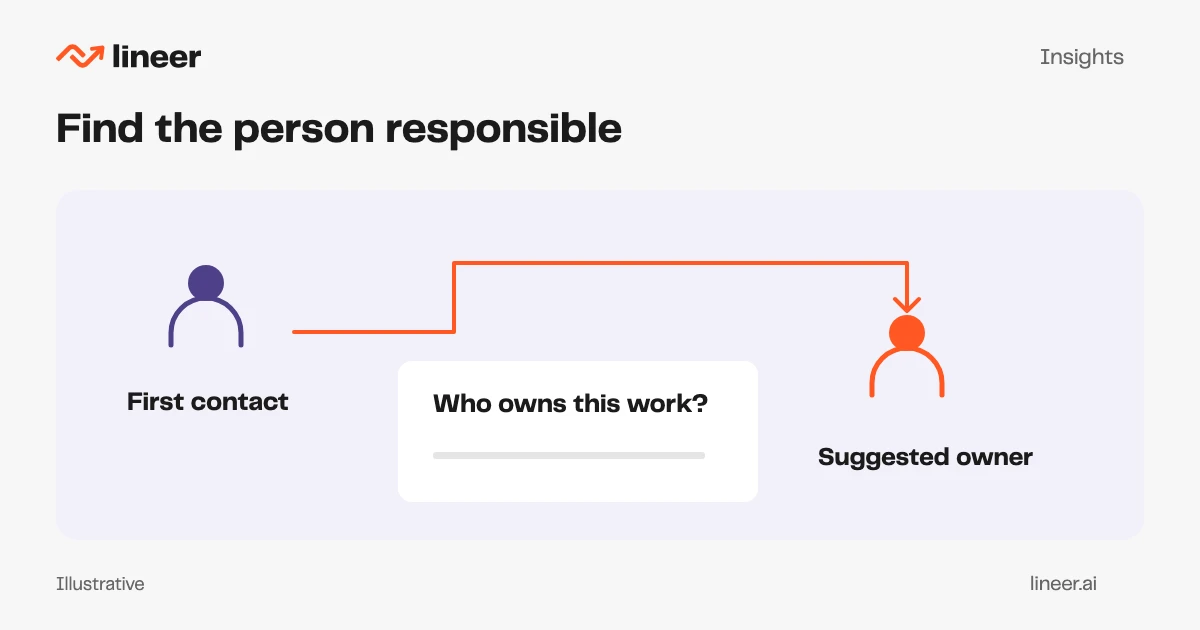
A “wrong person” reply gives you a chance to correct who you contact before sending another follow-up. The useful decision is whether the work belongs to someone else at the company or whether the company itself falls outside your audience. A seller can pursue a relevant introduction in the first case and close an unsuitable approach in the second.
In a pooled review of Lineer outreach, five of 45 first replies primarily directed the seller elsewhere. Eight identified a mismatch with the recipient’s business or role. Those replies show why a seller needs a process for handling corrections to the audience. This guide sets out our recommended process, with three illustrative emails you can adapt.
The correction determines whether the account is worth pursuing
A role mismatch can leave the original reason for targeting the company intact. If the recipient tells you purchasing handles supplier reviews, you have learned where to investigate next. Check that your offer fits that work before contacting the team. Their job title alone cannot establish whether they own the decision.
A business mismatch can undermine the reason for contacting anyone at the company. If you approached an adviser as though they operated facilities, another employee may be equally unsuitable for that offer. Update the account research and check how the same assumption entered your prospect selection. Our prospect selection guide explains how to connect an ideal customer profile with a relevant responsibility.
Ask one question the recipient can answer
A question about responsibility asks less of the recipient than a request to arrange your next meeting. If they have only said that the work sits elsewhere, ask which team handles the specific activity your offer concerns. Give them enough context to answer without having to interpret your product.
The reply also sets a boundary for continuing. If the recipient asks you to stop contact, honor that request. If they have already named the relevant colleague, use that information and avoid asking them to repeat it. We recommend a person handles the exchange as soon as a human reply arrives and checks that the automated cold follow-ups have stopped.
The following examples use a fictional supplier-review service. They are editorial adaptations of pooled reply categories, with original wording and no measured performance claim.
Email anatomy
Ask for the function that owns the work
Select a marked passage to see its purpose.
Evidence boundary Editorial example informed by pooled routing and mismatch categories. Fictional wording, with no measured outcome.
A colleague’s name gives you a new contact whose interest is still unknown
A routing reply establishes where the original recipient thinks you should direct the question. It does not establish that the colleague has a need, wants a meeting or has heard of your service. Give the new reader a short explanation of the offer and a next step they can assess for themselves.
The strength of the introduction should match what happened. Use “pointed me to you” when someone directed you to a colleague. Reserve “recommended we speak” for an actual recommendation. If you were given a shared mailbox, address the responsible team and avoid inventing a named owner.
Email anatomy
Write to a named colleague without implying an endorsement
Select a marked passage to see its purpose.
Evidence boundary Editorial example for a fictional service. Use only when a contact has actually directed you to this colleague. This wording has not been tested.
Forwarding the whole thread can expose context the new reader doesn’t need. Send a concise introduction with the relevant facts, and share the earlier exchange only when it helps and is appropriate. A request for information from the new contact can then be handled using the information-request guide.
A poor-fit account gives you a reason to change the selection rule
Closing an unsuitable approach helps the next campaign only if the correction reaches whoever chooses prospects. Record the specific difference between the role or business you expected and what the person explained. Then check similar accounts against that distinction before sending more outreach.
An adviser, supplier or referral partner can still matter to a business through another relationship. Pursue that relationship when it fits your strategy and you have a relevant reason to approach them. The original direct-buyer offer needs to be reconsidered first.
Email anatomy
Close the exchange when the business does not fit
Select a marked passage to see its purpose.
Evidence boundary Editorial example reflecting a different pooled reply category. No customer message is reproduced.
Give the new conversation an owner and its own outcome
A handoff can fail when the seller records a name but leaves the next action unassigned. Record who was suggested, why that person was suggested and who will check the fit and contact them. Keep the original recipient’s correction with the account so someone else does not restart the same unsuitable sequence.
Report routing according to the goal of the campaign. In a campaign seeking relevant introductions, a referral can meet the defined goal. In a direct sales campaign, the new contact’s interest remains unconfirmed until they respond. The reply-classification guide explains how to record a useful action without counting it as a meeting or sale.
What the Lineer evidence supports
The audit began with 3,097 opening outreach emails and reviewed 45 first reply candidates received within 14 days, before a second recorded send. Five had referral or owner routing as their primary meaning, while eight identified a business or role mismatch. A separate reply expressed interest with a referral and was counted under interest. Each reply received one primary category.
An opening was the earliest retained send in its outreach record. Some replies disclosed prior contact, and the available time before another email varied. The audit describes the replies received. It does not show how many routing replies produced an introduction, meeting or sale. The response process and examples above are our editorial recommendations.