AI CRM use cases: research, outreach and relationship follow-up
Three repeatable sales workflows, the output to inspect and the decisions your team keeps. A practical guide grounded in Lineer's product behavior.
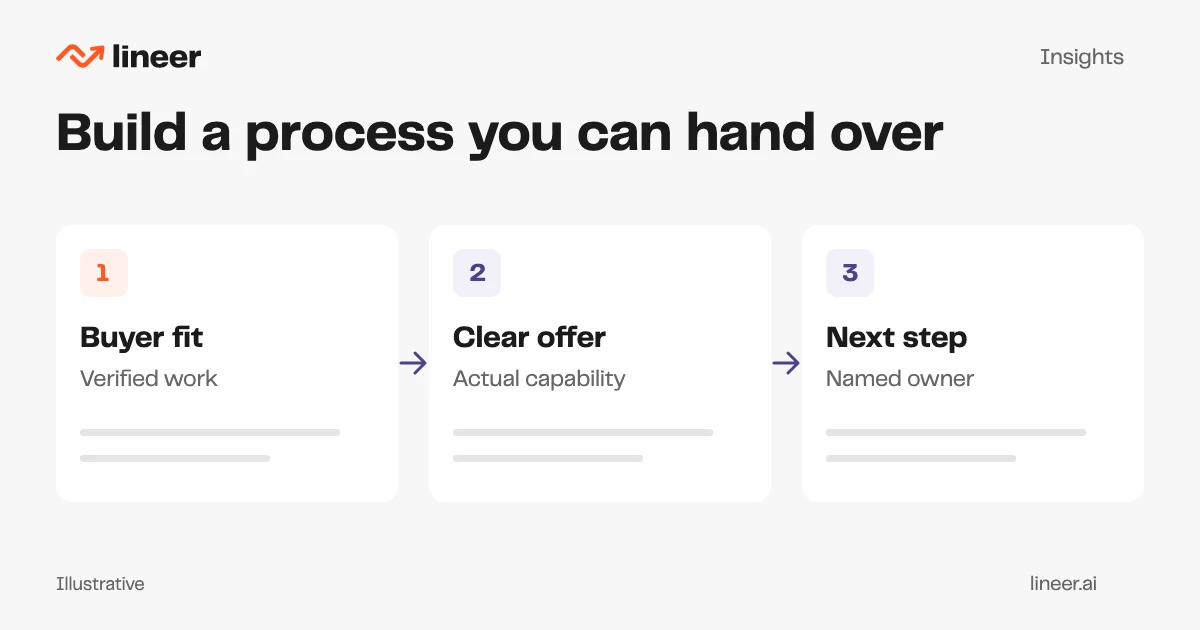
AI CRM use cases are easiest to evaluate when the work follows a repeatable process and someone can inspect the result. Researching an account, preparing an introduction and continuing a recorded conversation each have inputs a team can define. An agent can perform parts of that work, while the team decides whether the information is relevant and the next action is appropriate.
This guide explains three workflows using Lineer’s documented capabilities, a verified reply-handoff example and founder guidance. Business scenarios and screenshots are illustrative unless identified as the observed example. The case demonstrates recorded actions, not higher reply rates, time savings or revenue. The evaluation criteria are our recommendations.
A useful AI CRM workflow has a defined input and a reviewable output
AI in a CRM becomes easier to assess when the team can say what the agent should produce. “Help with sales” leaves both the task and the acceptance criteria open. “Research whether these companies operate regional facilities, retain the supporting source and prepare an introduction for review” gives the reviewer something concrete to inspect.
The CRM provides relationship context, while the agent performs selected work using its configured tools. Those roles overlap without becoming interchangeable. A stored job title is a record; an interpretation of why that person might need your service is a judgment. Your review needs to distinguish the two before that judgment appears in an email.
| Use case | Input to define | Output to inspect | Decision your team keeps |
|---|---|---|---|
| Account research | A company, a qualification question and suitable sources | Findings and the source behind each relevant claim | Does the account meet the conditions for our offer? |
| First outreach | Verified context, the real offer and sender instructions | A draft addressed to the intended person | Is the connection between the research and the offer justified? |
| Relationship follow-up | Available conversation history and a reason to return | A proposed continuation of the conversation | Does this action respect the recipient’s latest response? |
This is a workflow-selection framework, not a ranking of features by return on investment. A team with a stable research checklist may start there. A team whose offer changes in every conversation may need to clarify its process before automating message preparation.
Account research can make the basis for qualification easier to inspect
Research has a useful output when it answers a business question and preserves the basis for the answer. A company description alone may leave the team no closer to deciding whether an account fits. For an illustrative supplier-review service, the relevant question might be whether a company manages suppliers across multiple locations. That is narrower than collecting every available fact about the business.
Lineer’s research tools include company and profile research, web search and website retrieval. Which tools an agent can use depends on its configuration. The practical review is whether the retrieved material supports the proposed qualification, whether it is current enough for the decision and whether the account has been matched correctly. A mention of expansion does not by itself establish a purchasing need.
A useful research instruction separates facts from unresolved questions. In the supplier-review example, record the source for a stated operating footprint, leave the renewal date unknown unless it is supported and identify the missing information the salesperson would need. Those are suggested review criteria, not a promise that every research run will produce complete information.
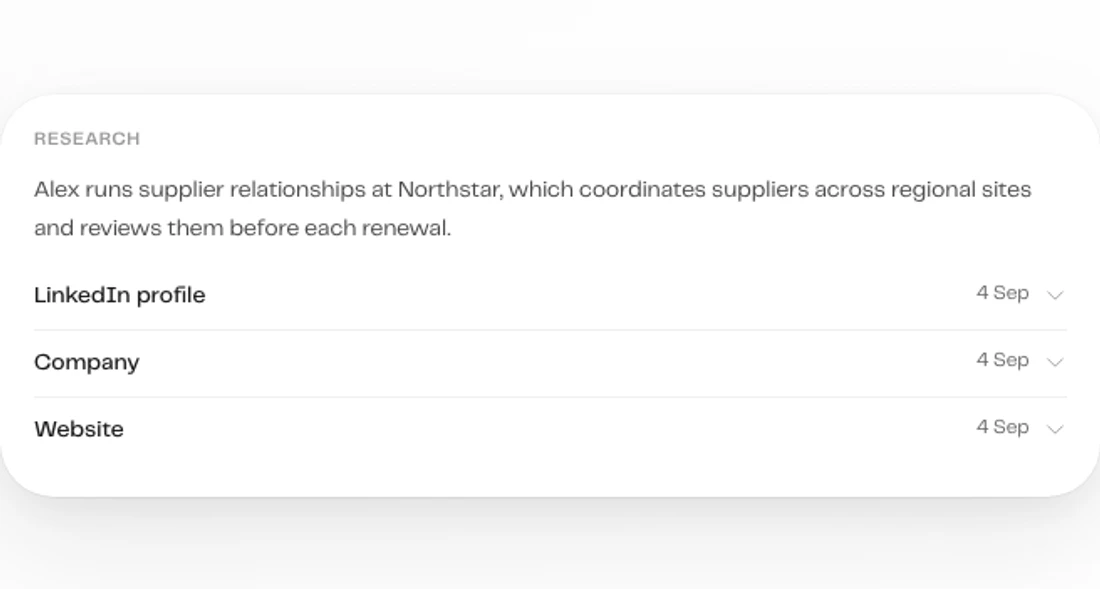
The research and tools page explains the available capabilities. Keep the qualification decision with someone who understands the offer, especially when a missing fact would change whether outreach is appropriate.
Drafting outreach connects research to an offer your team can verify
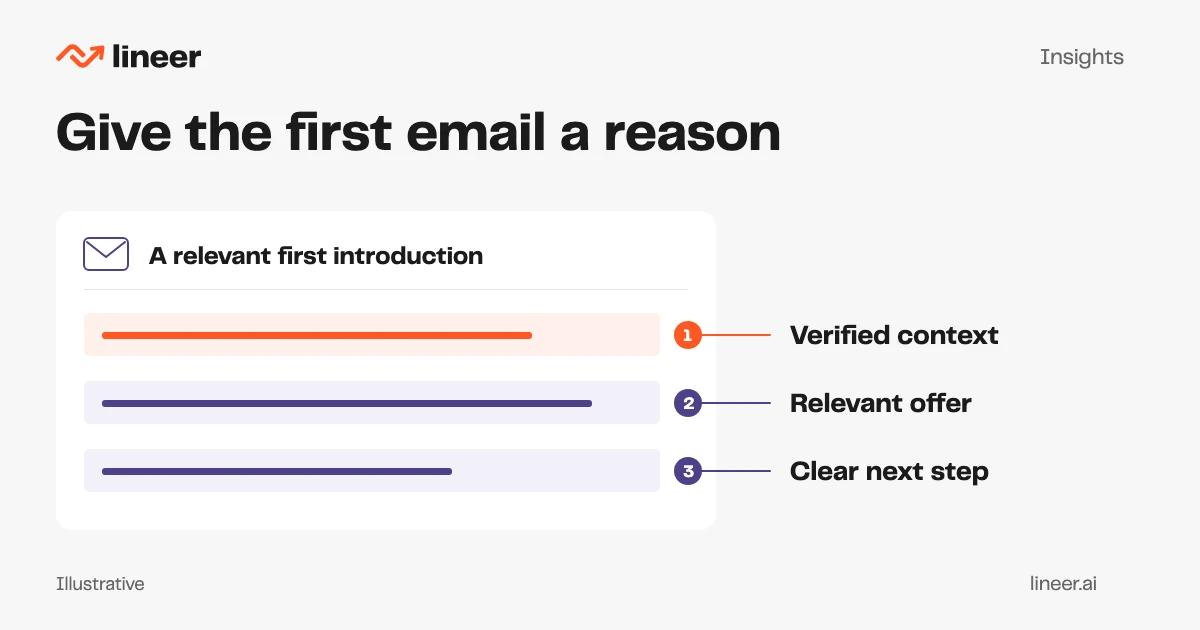
A draft is useful when its reasoning can be checked before it becomes an external message. Accurate account information can still support an irrelevant introduction. The review therefore has two parts: whether the research is true, and whether the proposed offer follows from it.
For the illustrative supplier-review workflow, evidence of regional operations might justify asking how supplier reviews are coordinated. It would not justify saying the prospect is struggling, has a renewal next month or will save a stated amount. The agent’s instructions should describe what your business actually provides and leave unsupported claims out of the message.
Lineer’s approval workflow lets a reviewer inspect a proposed message and approve or reject it, with editing available in the review interface. Approval requirements depend on the setup; automatic sending is also possible when configured. For an initial evaluation, we recommend retaining approval on external messages so the team can inspect recurring errors before allowing more autonomy.
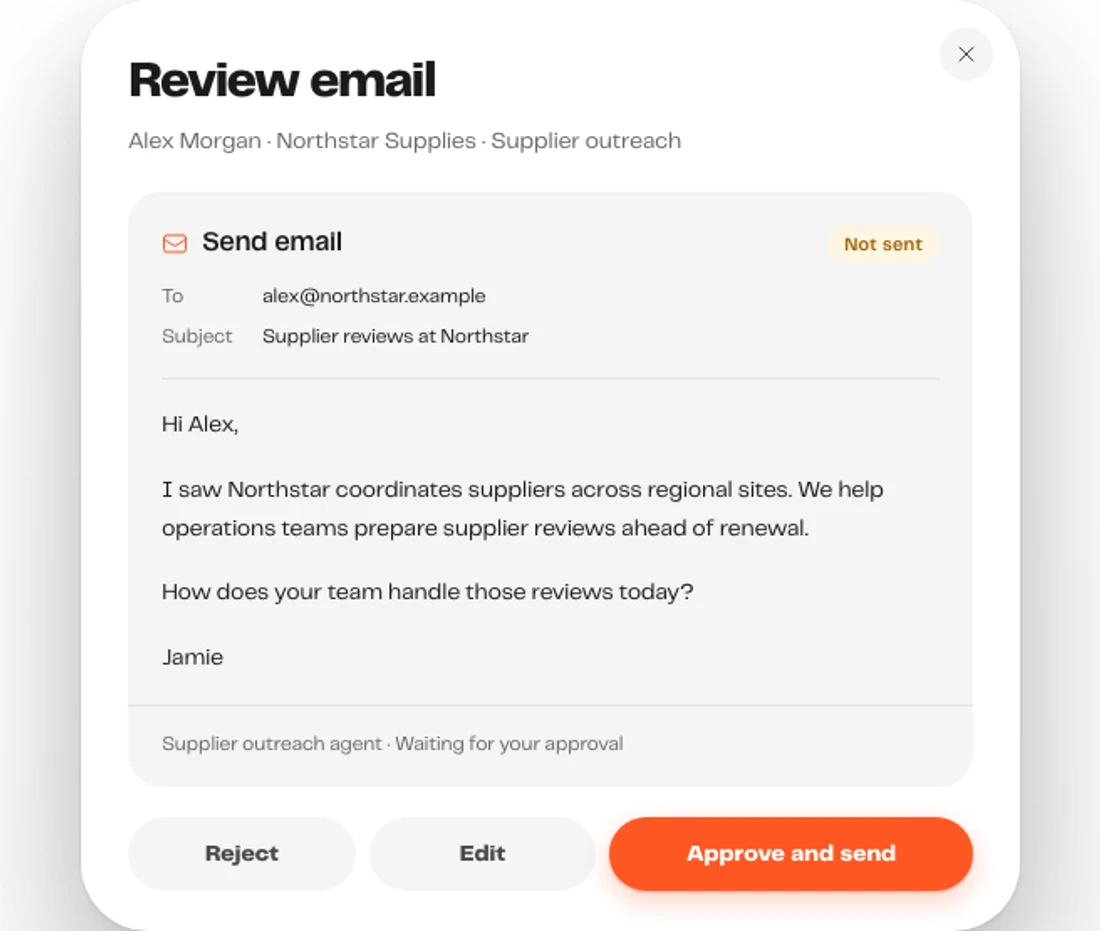
The most informative review notes explain why a draft changed. “Wrong company,” “unsupported need” and “offer does not fit” identify different problems. Rewording every draft without recording the reason makes it harder to decide whether the audience, research instructions or message instructions need attention. Our first-touch email guide develops the message-level decisions separately.
Follow-up needs the relationship’s latest context
The latest reply can change what the next message should do. An unanswered introduction, a request for information and a request to return later are different situations. A workflow that treats them as the same event risks continuing a sequence after the reason for the sequence has changed.
Lineer organizes prospect work into individual threads that retain messages, research and tool activity. Its outreach and nurture workflows provide ways to continue contact, but the team still needs to define the purpose and inspect the available history. For an illustrative prospect who requests details, a useful continuation addresses that request; for someone who asks to be contacted later, the requested timing belongs in the next-action decision.
Available history has limits. A conversation held by phone, in another inbox or outside the workspace may not be visible to the agent. Confirm that relevant context has been recorded before relying on it, and keep a human owner for responses that require a commercial judgment. The existence of a prospect thread does not prove that every interaction with that person is present.
This use case explains relationship context rather than prescribing a nurture cadence. We have not established an optimal interval or a nurture performance benchmark for this article. The nurture agent page describes the product workflow, while the follow-up guide and reactivation guide address those different writing situations.
A genuine reply is the point to hand the conversation to a person
We generally recommend handing the conversation to a person as soon as the prospect sends a genuine reply, whether positive or negative. Lambros Photios, Lineer’s founder, describes the purpose of AI-assisted cold outreach as improving the chance of starting a conversation in an environment where getting attention is difficult. Once someone responds, the recommendation is for a person to take responsibility for that interaction.
That boundary changes what the automation is trying to achieve. Research, drafting and unanswered follow-ups help initiate contact; a reply gives the team something specific to address. A request for information needs a relevant answer, a correction needs acknowledgment and a decline should be respected. Positive sentiment is not a prerequisite for handing the conversation over, and a negative reply is not a reason to keep an automated pitch running.
An anonymized event-sponsorship thread shows this handoff in practice. After receiving an introduction, the prospect asked for more information. The recorded actions show the planned follow-up wait canceled, the reply forwarded to a human with a summary of the request, and the automated conversation ended. The forwarding action completed, but the reviewed records do not establish what the person did afterward or whether the exchange produced a commercial outcome.
The campaign’s current instructions explicitly require forwarding genuine replies instead of answering them automatically, then ending the automated conversation. Those instructions were updated after the exchange, so they cannot establish the exact prompt wording used at the time. The action records support the handoff itself; Lambros’s explanation supplies the broader recommendation behind that approach. This is a recommended workflow to configure, not a claim that every Lineer customer or agent already follows it.
A useful evaluation measures corrections as well as completed work
A completed task shows that a workflow ran; it does not establish that the output was useful. An evaluation should therefore record the inputs, generated work, reviewer decisions and reasons for correction. This provides a way to distinguish a configuration problem from a process that is too ambiguous to automate reliably.
Choose a bounded batch your team can inspect and use the same acceptance criteria throughout. For research, check source support and account fit. For drafts, record factual corrections and changes to relevance. For follow-up, check that the latest known response and the next action agree. These are proposed evaluation measures, not metrics calculated from Lineer customers.
Commercial outcomes require a separate observation plan. If you later compare replies or meetings, define the contact group, prior relationship, sequence stage, denominator and observation window before drawing a conclusion. A mixture of first introductions and existing conversations cannot establish the performance of either workflow on its own.
The first workflow to automate should be one your team already knows how to review. Write down its inputs, expected output, approval boundary and exceptions, then explore how Lineer’s agents could perform the repeatable steps. That gives the evaluation a clear question: does the proposed automation produce work your team can use under the conditions you have defined?
Sources and evidence boundaries
Product behavior was checked on November 10, 2026 against Lineer’s public agent workflows, research and tools and approval controls, alongside the local research-tool definitions, prospect-thread routes and approval-record implementation. Source inspection confirms implemented mechanisms; it does not independently verify every production configuration or outcome.
The handoff example was checked against an individual October 2026 conversation and its agent action records using read-only database queries on November 10, 2026. It was purposefully selected, not drawn as a representative sample, and supports no performance-rate or causal claim. Founder guidance on handing genuine replies to people was supplied by Lambros Photios on November 11, 2026. Other business scenarios are illustrative. Screenshots reproduce public website product illustrations, not live customer workspaces. No claim is made about automatic lead scoring, revenue forecasting, universal CRM synchronization or guaranteed research accuracy.