A B2B lead nurturing strategy for the conversation after a reply
Build a lead nurturing plan around the prospect’s situation, a human owner and a useful next step. Includes observed Lineer conversations and annotated adaptations.
A useful B2B lead nurturing strategy gives each relationship a reason for the next contact. Someone who wants to meet, someone who needs evidence and someone who has no current need should not receive the same follow-up simply because they replied to an email.
Lineer records show why those distinctions matter. In one conversation, a prospect expressed interest but the exchange remained focused on finding a suitable meeting time. In another, the prospect explained that their existing arrangement already met their needs while remaining open to a conversation. The seller acknowledged that position instead of treating the reply as proof of a buying requirement.
This guide turns those observations into a recommended process: confirm fit, record the prospect’s situation, assign an owner, choose a useful next step and check what actually happened. The examples are selected conversations, not a performance study. They do not establish an ideal cadence or a nurture conversion rate.
Define which relationships belong in the plan
Lead nurturing develops a relationship over time by responding to what the person needs to understand or decide. Lead generation creates the initial opportunity to connect. A cold follow-up seeks a response to unanswered outreach; this guide focuses on the more specific work that begins once a person has engaged. That distinction stops an unanswered introduction from being counted as an active buying conversation.
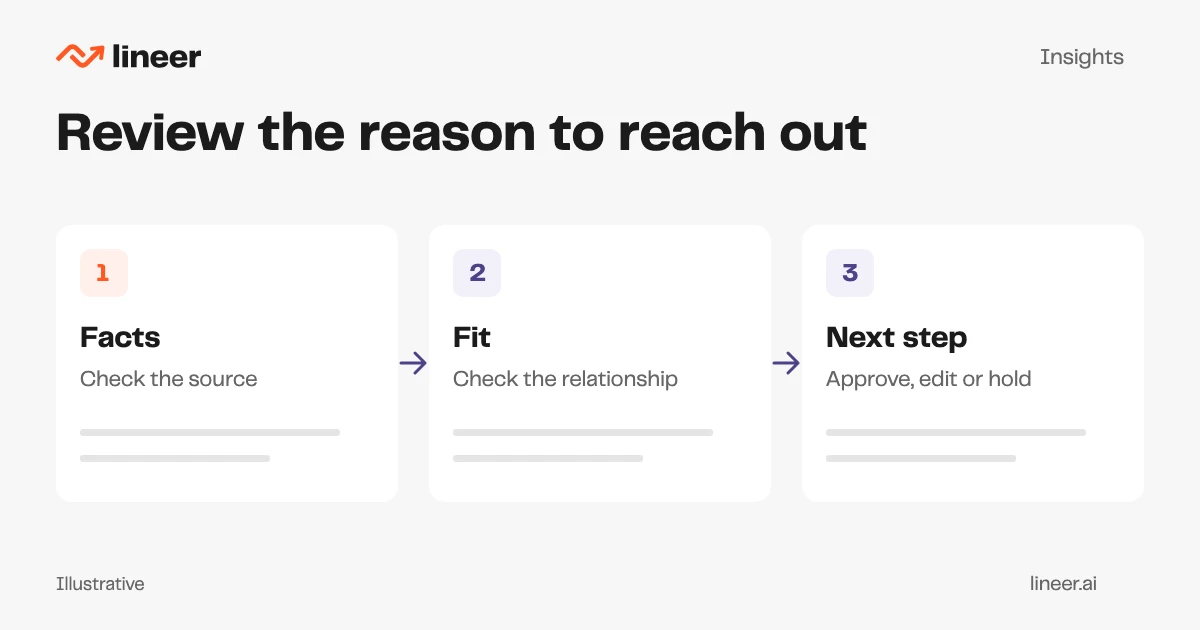
Your ideal customer profile still matters after a reply. Confirm that the company, role and potential use of your service fit the relationship you want to build. A polite response does not establish a need, and a request for information does not establish budget or buying authority. Use the prospect selection process to check the underlying fit before committing more time.
Referrals and outbound can both lead to worthwhile relationships, but they provide different context. A referred prospect may arrive with an introduction and a specific question. An outbound prospect may still be deciding whether the conversation is relevant. Record the source and what is already known, then use insights from both channels to improve the questions you ask.
Segment by the next decision the prospect needs to make
The reason a relationship is waiting is more useful than a broad label such as “warm.” A person comparing options needs different support from someone who has already agreed to talk and is trying to find a time. The following categories are a recommended working model, not a set of stages measured across Lineer customers or built-in product labels.
| Current situation | Useful next step | Evidence of progress |
|---|---|---|
| Wants information | Send the specific material requested and answer the question | The person confirms whether it addresses their concern |
| Open to a conversation | Agree a time or use the booking method they offered | A confirmed appointment, then a separately recorded meeting outcome |
| Interested, timing unresolved | Establish the practical constraint and agree when to return | An agreed date or a relevant change to review |
| Current arrangement meets the need | Clarify whether staying in contact would be useful | Permission and a reason to reconnect, rather than an assumed opportunity |
| No fit or no further contact wanted | Close the sales next step and record the restriction | The record prevents inappropriate follow-up |
A prospect’s own explanation should take precedence over your initial research assumption. In one reviewed Lineer thread, the outreach connected a business expansion to a possible conversation about funding. The prospect replied that existing funding was already available at attractive rates, while offering a time to talk. The seller acknowledged that the current arrangement might be sufficient and suggested a later time because of their own availability. The retained thread does not show a confirmed appointment or a sale.
Openness to a conversation and an unmet need are separate facts, and both belong in the relationship record. The prospect’s current arrangement explains their position today. It does not establish whether future projects, introductions or a later supplier decision could make the relationship valuable.
A suitable existing supplier can still leave room for a relationship
A prospect does not need to replace their current supplier for staying in touch to be worthwhile. Lineer founder Lambros Photios points to several possibilities: future projects may create different needs, the supplier they use today may change, and the person may introduce you to prospective customers or referral partners. They may also invite you to compete as a challenger when an opportunity arises. Those are reasons to understand the relationship’s potential without assuming dissatisfaction with the incumbent.
The reason you maintain the relationship should guide what you discuss next. A future project may make a conversation about requirements useful. A potential referral relationship may warrant explaining which customers you can help. If the prospect later wants an alternative supplier to compare, relevant experience can help them decide whether to include you. These are practical applications of Lambros’s perspective, not outcomes established by the reviewed email threads.
Keeping in touch should build familiarity with what each party does and where they could help each other. Record the possible value of the relationship alongside the current buying situation, then choose contact that adds something relevant. That might be a useful introduction, information connected to a project or a conversation about an upcoming decision. The purpose can develop over time; it does not have to begin with an immediate sales opportunity.
Give the relationship a human owner
A genuine reply changes who should decide what happens next. Lineer founder Lambros Photios recommends handing the conversation to a person as soon as someone responds, regardless of whether the response is positive, neutral or negative. AI can help initiate contact and prepare context; the human takes responsibility for understanding the reply and choosing the next interaction.
Ownership needs a specific action to be useful. In another reviewed thread, a prospect expressed interest in discussing growth. The seller suggested possible meeting windows and later followed up with alternatives. The records also contain a task to confirm a time. This shows an interest-to-scheduling process; it does not establish that the meeting subsequently took place. A completed task alone would not resolve that uncertainty.
A neutral email can still justify a human conversation when the recipient is open to it. If an exchange is becoming slow or ambiguous, the owner can suggest a call to understand the situation and establish a connection. Respect the person’s preferences and any restriction on contact. Continuing by email indefinitely is not a strategy simply because email started the relationship. Our human handoff guide covers the transfer and channel decision.
Let the agreed next step determine timing and content
The next contact should resolve the current question rather than restart the pitch. If the prospect asks for a case study, send relevant evidence. If they offer a booking link, use it and confirm the arrangement. If they ask to return after a planning cycle, record that timing and the reason. These are different jobs, so they do not need a universal sequence of messages.
A third reviewed Lineer thread illustrates the difference between agreement and execution. The prospect offered a booking link, and a later message from the seller confirmed a time. That is evidence of a booking confirmation in the conversation. It is not proof of attendance, a qualified opportunity or revenue. Your records should keep those outcomes separate.
The annotated examples below are fictional adaptations of the decisions in these conversations. The wording, names and circumstances have been generalized. They illustrate recommended human responses, not messages proven to perform better.
Email anatomy
Respect an arrangement that already works
Select a marked passage to see its purpose.
Evidence boundary Editorial adaptation of a decision observed in Lineer records. This is not the customer’s message or a measured winning template.
Acknowledging an existing arrangement gives the prospect room to explain whether further contact would be useful. The first example deliberately avoids introducing an unverified problem or treating willingness to talk as buying intent. Send it only when the person’s actual reply supports that understanding.
Email anatomy
Resolve the meeting time without repeating the pitch
Select a marked passage to see its purpose.
Evidence boundary Fictional wording based on an observed scheduling situation. Dates and context must be checked before use; no performance claim is attached.
A scheduling follow-up should make the outstanding decision easier without reopening the entire sales argument. The second example offers concrete choices and lets the recipient defer. Once a time is confirmed, replace the scheduling task with preparation and a record of what the conversation is meant to establish.
Keep a short plan that another person can act on
A relationship record is useful when someone else can understand why contact is due. “Follow up” leaves the owner to reconstruct the conversation. A short note containing the prospect’s situation, the agreed action and the reason for its timing makes the work repeatable without scripting every human response.
A practical lead nurturing plan
Adapt this record to one real relationship. These are recommended fields, not default Lineer stages.
- Fit
- [Why this company and person belong in this relationship]
- Situation
- [What the prospect has actually said; keep assumptions separate]
- Question
- [The decision or information they need next]
- Owner
- [The person responsible for the relationship]
- Next step
- [The action agreed, or the question still needing agreement]
- Timing
- [Date or trigger, and why it is appropriate]
- Channel
- [Email, call or another agreed route]
- Boundaries
- [Contact preferences and conditions that stop outreach]
- Outcome
- [What happened; distinguish proposed, confirmed and completed]
- Review
- [When the owner will reassess unresolved work]
Review the plan when something meaningful changes. New information may justify a different conversation, a later return or closing the opportunity. If the person has not agreed to continued contact, decide whether there is a reasonable next step before placing them into recurring outreach. A request to stop ends that contact plan.
Automate the repeatable work around the conversation
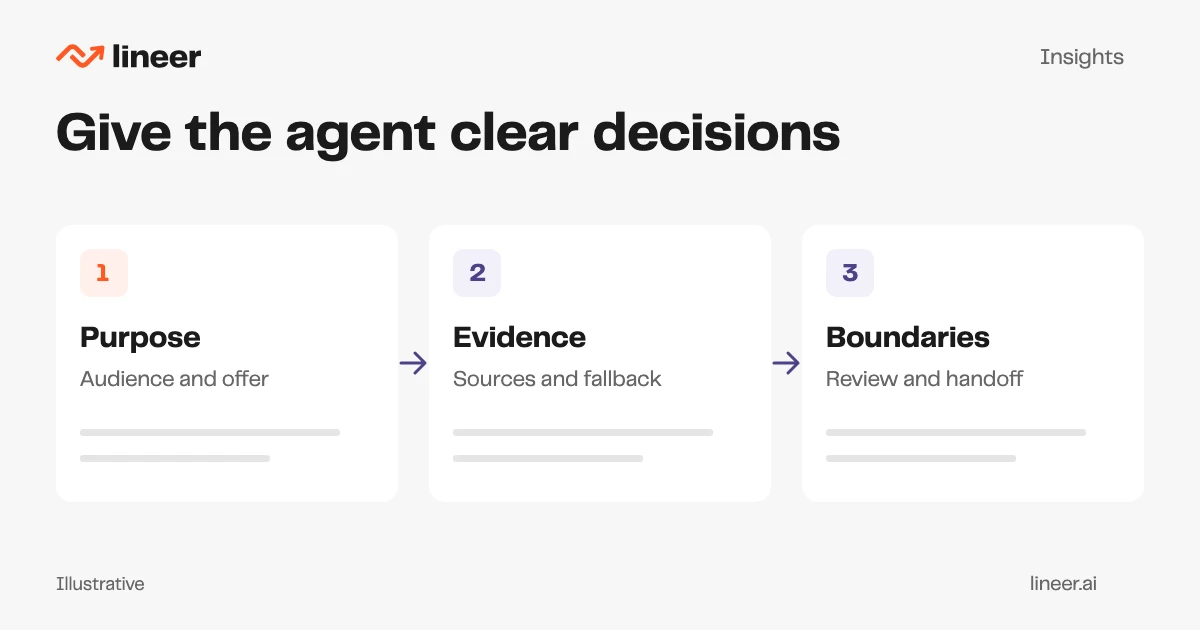
A consistent process makes it easier to identify work that software can support. Research preparation, organizing context and preparing drafts are different from deciding how to respond to a person’s concern. Lineer’s nurture agent is one part of that workflow; configure instructions and review requirements around the process your team has actually defined.
We recommend establishing the process manually before automating repeated parts. Agree what counts as a useful next step, who owns it and what should stop the workflow. Inspect the resulting actions and keep a human responsible for replies. The current campaign configurations reviewed for this article included forwarding and no-auto-reply settings, but they were updated after the example conversations. They do not establish the historical instructions or explain why those earlier outcomes occurred.
Measure movement in the relationship, not just email activity
A reply, a booking and a sale answer different questions. Keep the stages separate so a rise in replies does not conceal relationships that never receive the promised next action. For an operational review, inspect whether each active relationship has an owner, whether agreed actions were completed and what the prospect actually did next.
Conversion measures need a defined group and enough time for the outcome to occur. For example, a meeting-attendance measure needs a denominator of confirmed appointments whose scheduled times have passed, with cancellations handled consistently. A nurture-to-opportunity measure needs a clear entry rule, an opportunity definition and an observation window. Do not combine unanswered cold outreach, reactivation and established relationships into one rate and call it nurture performance.
The immediate starting point is one segment of real relationships. Review the latest conversation for each, record the reason for the next contact and assign the person responsible. That gives your team a process to evaluate before increasing the amount of outreach.
Evidence and sources
This guide draws on a read-only review of selected Lineer email conversations, linked agent actions, tasks and current campaign settings. The examples show seller correspondence, scheduling activity and differing levels of interest. They do not establish long-term nurture performance, attended meetings or sales. Sender and action records support treating the later correspondence separately from the recorded automated outreach, but do not independently authenticate who typed every message. Customer identities and private messages are omitted.
The recommended human handoff approach comes from Lambros Photios’s guidance. The process, proposed stages and annotated adaptations are editorial recommendations. For broader context, Salesforce describes lead nurturing as developing relevant relationships over time. Its general guidance is not evidence of Lineer outcomes.